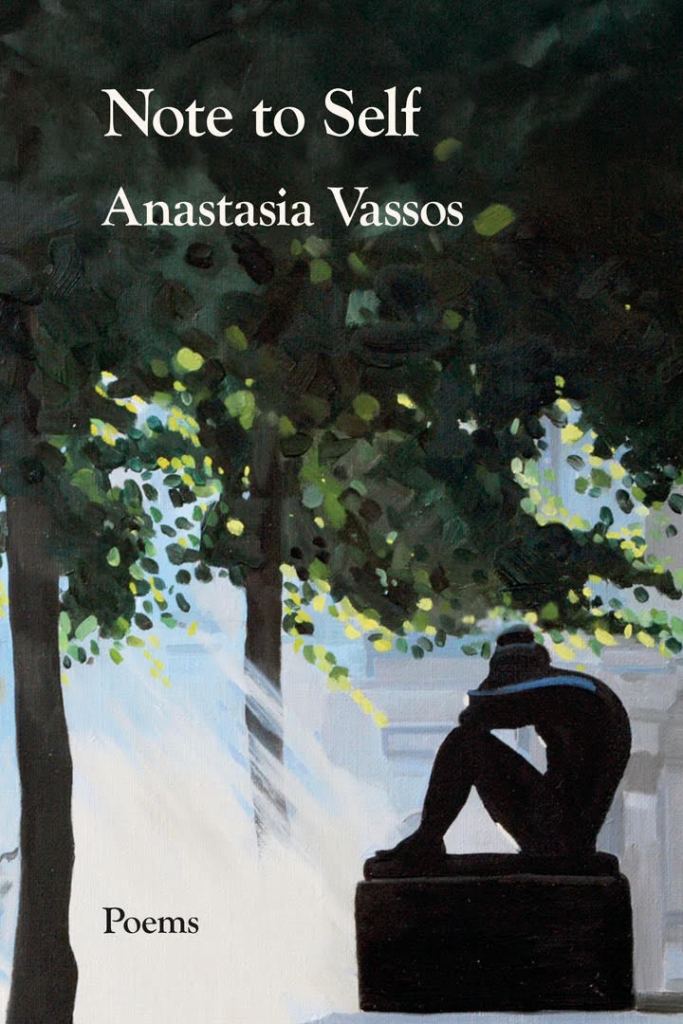
Note to Self/ poems by Anastasia Vassos / book review by Alec Solomita
Alec Solomita’s review of Note to Self by Anastasia Vassos (Kelsey Books, 2026)


Anastasia Vassos’s third book of poetry, like her first two, straddles the world from Boston with its “toothy skyline” to Mt. Athos where “We watch hermits / locked by faith on the mountain.” But more than the ubiquitous, graceful geographies of “Nostos” and “Nike Adjusting Her Sandal,” her latest collection, Note to Self, explores the heart of the writer. This new book travels into the narrator’s emotional and spiritual interior with a beautifully scripted candor – intimate, bold, and passionate.

Here, Vassos shares with the reader her several powerful preoccupations: persistent grief at the loss of her mother, the body’s fragility, the beauty and terrors of the physical world, and not least, the question of faith. In some poems these concerns appear simultaneously.

		How the painting’s yellow wash pulls me
		to my mother
		because she loved yellow

		How I thought of God this morning
		as I pedaled my bicycle past the ocean
		I love best —

		wondering whether I’m foolish to pray—

Leaping from one thought to another is typical of Vassos, and the fact that they make perfect affective sense is also typical.

the ancient Greeks believed ichor
		a fluid that lives forever
		flowed in the veins
		of their gods

		it rained on such dry soil last night
		the petrichor rose up
		from dusty rocks

		what is nostalgia
		but a keen sense
		of smell


These darting insights and her deliberately rare use of conjunctions render a startling immediacy to deceptively disparate phrases. And while her concerns are often melancholic and questioning, her sense of humor appears in unexpected places:

 Ode to My Spleen
		Little Blood Purifier.
		Everything inside my body
Is what I cannot see.
I surrender my laughter: infectious.
The white flag of my open palm.
Can you explain penance?
The lifeline that haunts the surface?
. . .
			define faith
The circumference of love. Is it the size of a fist?
God. The birth of Polaris.
The beach where Achilles wept.


Vasoss’s ability to move through several emotional registers in a single poem is one attribute that makes her work commanding. Many of her poems hold tragedy and comedy in a delicate balance. She can speak of great loss and then break into an antic note that delivers a startling relief from heartbreak.

In her series of letters to a dear, lost friend, the Orthodox priest Peter, her poems often manifest a sense of absence that only the longest, most intimate friendships preserve when the lifeline is cut.

song for Peter the Priest who sang
before he died

where flung
my friend
now what
earth swallows
where flown
. . .

gasp full of what
echo of gasp
echo of echo
your throat
full of birds
their songs like gospels

These severed, grieving lines — culminating in the gorgeous metaphor of birds — are turned on their head in another poem to her friend.


		Letter to Peter the Priest as He Awaits
			the Day of Judgment

		If you see Aunt Helen tell her
		I still have the gold hoop earrings.
		. . .
		I wear socks to bed.
But why am I telling the dead
something they already know?
Show me the profile of Jesus
		on this morning’s burnt toast, the Facebook
		post of the horse your rode in on
		. . .
		Tell me about the afterlife:
		do you still wear the collar? Those shiny clerical robes?
		Do you have a body?
		Have you met St. Demetrios?
		Find out if St. George is still slaying the dragon,
		his horse bucking under him.

Yet even here, as she ends this mischievous interrogative, Vassos rings a tender note:

		I’m left with the lamentation of the sky.
		I’m left with two gold coins I forgot
		to place on your eyelids when you fled.
		Tell me: is there really a river?


Vassos possesses a nearly tactile response to the visual. Her many apprehensions of the sun illuminate this aspect of her work. “It’s October, the sun burns / its pat of butter on the air.” (Garden State) “The sun’s dying pours / yellow pigment in the foyer / and douses the stairway” (Stick Season) “I look out the dusty window / the sun is pouring oil / across the face of buildings” (At the Post Office). And in her sad, charming poem, “The Day Jack Gillbert Kissed Me”: “All I can say is the sun— / I'm sure of this— / was a hot knife slicing.”

The poet has a personal relationship with the sacred, or the lack of it. More than a few of her poems address her struggle with faith or more accurately her yearning, her hunger for meaning in the form of a god, an afterlife, a not-ending. She experiences this hunger as a physical roiling, a feeling she likens to an interior hummingbird. “The hummingbird sipping bougainvillea / inside my chest.”

In her “Letter to God, Just in Case,” after starting with an almost childlike rocking cadence, the writer moves on to explicate the hummingbird more fully — and delves explicitly into the ultimate question of theodicy.

		Letter to God, Just in Case
		What I mean to say is
		I’m lonely. I haven’t been praying.
		I forgot to pray in February
		and I’m sorry—
		if you’re there, you probably know
		it’s March now—light wanders past 5 p.m.
		The hummingbird in my chest
		sputters against my sternum
		looking for a way out.
		. . .
		How does it feel to watch us suffer?
		Just last night a child was abducted
		In a stolen car north of here.
		. . .
		The hummingbird is still
here stammering in my chest.

Elsewhere, Vassos writes of more earthly matters, from an MRI to the warmth of a local lake (“how my body / in the soft water, the lake / calm, the silk of it”), to training on her bicycle. Sometimes poems surprise with a kind of breathless sexiness that seems to break in unexpectedly.


					oh such pleasure it is
		to remember love
		and every young man
		I kissed in college
		their long hair luminous, falling in their eyes—
		that ringing in my ears
		the rain

And in another poem, she reports with a frank sensuality “The body I clothe is mine. / I wear you, unbuttoned.”

Vasoss’s poems are all unbuttoned in one way or another, and at the same time all are meticulously composed. Their heart and soul are unbuttoned as they reveal their secrets in rigorous, breathtaking verse.

“Earliest light streaks the window,
ignites my own hand as I meet
myself on this page.”

/////


Anastasia Vassos, the daughter of Greek immigrants, was born in Cleveland, Ohio. Her poems have been nominated for the Pushcart Prize, Best of the Net, and Best New Poets. She is the author of the chapbook Nostos (Kelsay Books, 2023) and Nike Adjusting Her Sandal (Nixes Mate, 2021). Her poems about the Greek-American experience have been translated into Greek. She is a reader for Lily Poetry Review, speaks three languages, and lives in Boston.

/////


Reviewer Alec Solomita is a writer working in Massachusetts.  His fiction and poetry have appeared in many journals and anthologies. His chapbook “Do Not Forsake Me,” was published in 2017. His full-length poetry book, “Hard To Be a Hero,” was released in 2021. He’s just finished his third collection, “Glass Flowers.”