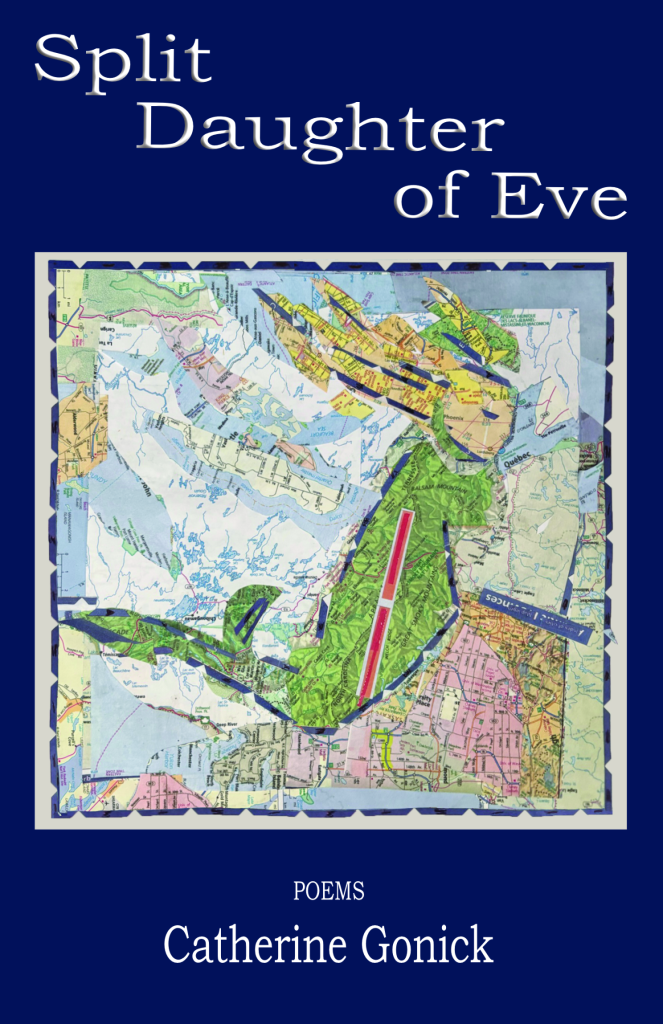
Split Daughter of Eve, Catherine Gonick (Sheila-Na-Gig Editions, 2025), Review by Barry Fruchter

In the first section of her debut collection of poetry, Split Daughter of Eve, Catherine Gonick dives deep into two worlds: the world of memory, as meticulously depicted as that of Proust, and the one that she never witnessed, the world before her birth.  In the poem “Origin Story,” she addresses this loss:
		My past changes without me
		an empty house
		that continues to weather.

That empty house lurks behind every poem in this book, imparting a kind of shadow objectivity to the poet’s razor-sharp memories of childhood, youth, adulthood, and old age. The world, Gonick shows us, really exists, independently of our confessions and recollections.  Ours is the task of adding our own personal, subjective record to it, a new set of layers like the veins of gemstone sparkling within the grey canyon walls.

Split Daughter of Eve ranges over three sections, each devoted to another slice of life, or rather, of lives. But above and beyond all else, it is devoted to the title concept, a daughter of Eve who remains split as all women do within patriarchy.  The book explores two recurring themes, that of family, genetic as well as chosen, and of Jesus the Man. Gonick adds still another layer by exploring the split caused by two separate streams of ancestry, one springing from 1,000 years of Polish Catholicism and the other from 2,000 years of Jewish history since Christ.  As the book progresses, in the sometimes harsh and sometimes gentle light of her dual inheritances, the gap between these streams narrows considerably.

One remarkable example of that narrowing is the poem “At Cousin Fanny’s Table.”  Henry had been an urbane and witty guest for years, at Fanny’s annual family Seder. But when the movie “Schindler’s List” appeared, he was moved to confess that he had been one of those saved by the list.   Henry had never spoken
about his past, yet after seeing the film unearthed
		his black-striped, brown, concentration camp uniform,
		which not even his wife knew he’d kept.

This reviewer found the poem especially moving as he remembered standing outside the Fabrika Oskara Schindler in the freezing cold of Krakow, Poland, and a bit later standing on the frozen wasteland that had been the terrible Plaszow camp where Amon Goeth took “target practice” at the Jewish prisoners.
Henry began to speak at schools to students who knew nothing of the Holocaust, with a new spirit of energy unleashed by the film. After the poet returned from a Polish tour of the film’s locales, Henry declared he would never go back there, but wanted to see her photos.   When they came to the one of the famous pharmacy (the subject of a fascinating book by the former pharmacist, who personally sheltered Jews in his building), Henry recalled:
		One day there was an aktion, he said.
		I would have been rounded up, but a Nazi who knew me
		was on duty and told me to go around the corner.

It’s been said that history doesn’t repeat itself, but that one episode rhymes with another.  In this case, a Passover Seder rhymes with several sets of memories.  And that is typical of many poems in Gonick’s book.
Just as in childhood the poet is drawn to the humanity of the crucified Jesus on the church wall, so in later years she befriends a Jesus who not only feels like a woman, but actually becomes one.  In the poem “Jesus and I Go to the Beach,” the speaker lays out a litany of unanswered questions about the Ascent of the third day.
How did it feel watching familiar faces grow smaller,
ever to be seen again?  Did he even look?

The Son of Man reads his companion’s mind and helpfully becomes a woman.  “Yes,” she says.  “The future in female.”  In some sense Jesus holds the place of the poet’s missing sister, lost to suicide on a freeway in California.
The venue of the book remains steady.  Though the official locales of these poems include Istanbul, Krakow, Crimea, and Bhutan, these are clearly masks of home.  But Gonick’s childhood California is a radically different thing from the hippie-vision of Joni Mitchell in the song “California Comin’ Home.”  In the end, it is a haunted stretch of highway, the dwelling place of restless spirits, a hidden god suddenly made visible.  This venue is expanded to what Hegel would call a “world historical” vision in poems such as “St. Teresa of Avilá Serves Lunch” and “Visiting the Convent at San Marco,” where we read about the poet’s childhood need for her own safe space, marked out by stones in the backyard, and later the equivalent at Saint Mark’s church.
		A home kept out strangers, a church
		let in God.  I hadn’t heard
		of open-air temples, the world
		as holy home, beit ha-kodesh.
		I loved feeling safe inside
		this open frame.

But then the poet encounters the monks’ cells at San Marco, where Savonarola was prior of the monastery until hanged and burned as a heretic. His black cloak remains, a presence unto itself:
		Displayed freestanding in the center
		of the room, the raven breathes.
And the world itself, in Gonick’s insightful vision, breathes before us. The reader is made richer by a journey through these poems.

/////
Read more of Catherine Gonick’s work and reviews here on Lightwood. Go to our Search Button and insert her name and click.
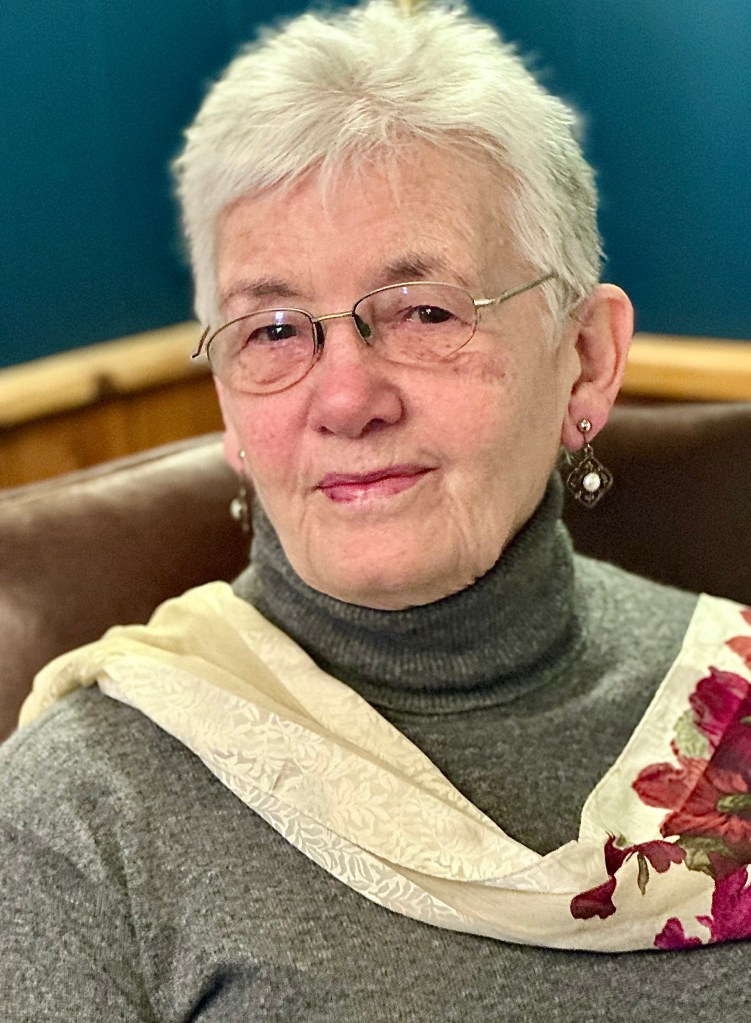
Catherine Gonick has published poetry in journals including Lightwood, Notre-Dame Review, The Orchards Poetry Journal and Pedestal, and in anthologies including Grabbed, Support Ukraine, in plein air, and Rumors, Secrets & Lies: Poems about Pregnancy, Abortion and Choice. She lives in the lower Hudson Valley and works with her husband
in a business that seeks to lower the rate of global warming. Her first collection of poetry, Split Daughter of Eve, is published by Sheila-Na-Gig Editions (2025).
The book is available for order at: https://sheilanagigblog.com/shop-sheila-na-gig-editions/catherine-gonick/
Reviewer Barry Fruchter
Bio: Barry Fruchter is author of 12 chapbooks of poetry for New Feral Press, in addition to the collection DOUBLE HELIX (Lamberson-Corona Press) and the novel BLISS (Overlook Press). A former professor of literature and Laton American Studies at SUNY Nassau, he now lives in the State of Washington.
 Lightwood