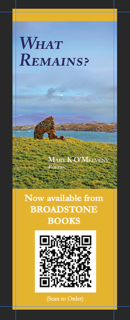
Mary K. O’Melveny’s What Remains? published by Broadstone Books
Reviewed by Jan Zlotnik Schmidt

In her latest volume, What Remains?, Mary K O’Melveny tackles large questions about existence that have plagued human beings throughout history and presents in nuanced and strikingly beautiful and evocative poems the struggle to find meaning and hope in times of personal, political, environmental, and global crises. She asks “what remains,” offering keen observations of the natural world, philosophical explorations, visions of the cosmos, and poems that witness disasters—man-made and global–that contrast with visions of beauty, traces of memory, and moments that provide sustenance.
In sensate and textured imagery, she explores traces of past civilizations that assuage her fears of the total dissolution of human endeavor and the diminishments that come with the inevitable flux of experience. Traces of the past remain and invoke memory and memorialization from 12,000 year-old fossilized footprints found in the Utah desert, to an exhumed gravesite of enslaved in Kingston, New York, to the detritus left by the droughts affecting the Colorado River, Lakes Mead and Powell, caused by our overheated planet. The presence of these traces leads to her wondering: “If luck holds, our own fossilized footsteps will one day emerge/to future explorers huddled fireside beneath somersaulting stars.”
Another aspect of this volume is the connections between bird song and music, tying together the natural and the artistic in profoundly unique ways and offering a reader new possibilities of experiencing both the natural world and music. For example, in “How to Get that Healing Feeling,” she revels in the music of her outside world, of “titmouse raps,”” a white-breasted nuthatch solo,” “a jazz grove”— “a soul solo that proves repair is possible.” Her words lead me to experience in new ways my walks on the rail trail near my home.
In addition, her poetic language describing natural phenomena is original and memorable. In “Mother Nature’s Jewelry Case,” daybreak is a jewel studded world: “shadow stripes of citrine, amethyst turquoise,” a “sapphire throated jay” a “ruby cardinal” all stand out in this morning scene. In other poems, her insistence on the miraculousness of creatures inhabiting the natural world affirms the bond between human and animal. “In What Whales Might Say About Syntax,” she imagines that “whale/canticles hint at some ghostly gospel choir.” When I read her poems that relate moments in nature, I see that world animated for me in new and exciting ways.
Additionally, her poems explore in intimate, lyrical language, the losses that shape our lives–the hardships of her Irish ancestors, the struggles of her father and mother, the deaths of her parents, among other experiences of sorrow. She encounters our war-torn world, imagining the Palestinians in the West Bank who have lost their land, the woman dying of starvation in South Sudan, the Holocaust survivor who commits suicide, the displaced immigrant set adrift by global strife, seeking refuge. She witnesses those experiences that attest to the fragility of human experience. And she expresses her grief, in a question: “How many tears has all of humanity cried?” in her poem, “A Sestina for Lachrymatories,” in which “bleeding hearts run like rivers.”
Finally, while the “nimbus of loss . . . remains,” the “tensile strength of touch,” suggests how we might survive all diminishments. The final lines of her volume affirm the necessity of reckoning with those “dark forces” that haunt us, that we cannot control, and yet with an understanding of “time’s long gaze. / We glaze over sorrows; let the sun blaze”:
Some ancestors dragged monoliths many long miles
to make their wishes known to celestial spirits.
To honor their dead. To sing odes to those once loved.
To ward away dark forces they could not tame. Are
we so different? We want to be visionaries worthy of
time’s long gaze. We glaze over sorrows; let the sun blaze.
In “Testing the Limits of Art,” she questions whether art can provide hope, whether art can help us transcend the daily horrors of our world. Perhaps one answer is this volume itself. Hers is a poetry of wonder, witnessing, revelation, and transformation.
////

Read more by Mary O’Melveny here on Lightwood. Go to our Search Button, insert her name and click.
Mary K O’Melveny, has authored five poetry collections and a chapbook, including If You Want To Go To Heaven, Follow A Songbird (Jerry Jazz Musician 2024); Flight Patterns (Kelsay 2023) (nominated for the Eric Hoffer Book Award); Merging Star Hypotheses (Finishing Line 2020), semi-finalist, The Washington Prize/The Word Works). Mary’s award-winning poems are widely published in print and on-line literary journals and poetry blog sites. Her fifth collection, What Remains? is published by Broadstone Books. She is a member of the Hudson Valley Women’s Writing Group and co-authored the Group’s two published anthologies, Mary lives with her wife near Woodstock, New York.
////
Reviewer Jan Zlotnik Schmidt is a frequent contributor to Lightwood and her writing and reviews can be read here. Her current book of poetry is Rose Petals Falling in the Grand Canyon: New and Selected Poems, published by Kelsey Books, 2026.

