It’s not fiction that’s the problem. You concoct a plot, you burnish it, buff it, stuff it, fold it, mold it, file the rough edges and Bob’s yer uncle, an artful work of fiction. It’s the factual stuff that can fail to resonate even when you have all the particulars in a comprehensive, chronological sequence because it can seem so academic. So when you have just a few basic details that barely form a narrative and yet you know the story is true the challenge is magnified. And that is the issue I’m facing here.
More than sixty years ago my grandmother told me about a dinner party she and my grandfather attended in about 1927. I don’t remember what prompted the reminiscence, but I do know exactly where it was that she told it to me—we were standing in her living room beneath a large portrait of her that hung over the fireplace, and I recall the slight smile of bemusement as she spoke. I was assuredly the only one of her grandchildren that she told, because she knew I’d be the only one interested in her story, so it’s not surprising that none of my siblings or cousins have any recollection of it.
The dinner party was held at the home of some friends of theirs in an area of Johannesburg called Northcliff, even though the entire ridge that dissects Johannesburg faces north and Northcliff is quite a way west along the ridge but not as far away today as it seemed even when I was a child. For my grandparents, the drive from their home in the Houghton Estate entailed a journey at pretty much the same elevation across the ridge—but who knows what the roads were like in those days, whether they were paved, whether there was lighting, and how long it took.
There were several other couples at the party, and all their children were at home with the nannies while their parents were out for the evening. But before they sat down to dinner, one of the women present had a sudden premonition that her children were in some sort of danger. Telephones weren’t ubiquitous in those days so she couldn’t just call, but such was her anxiety that her husband agreed to drive her home so she could reassure herself that all was calm. And apparently it was. They drove home and found the children quite safe with the nanny and no doubt with a huge sense of relief, since it was early enough in the evening, they turned around and drove back to join the dinner party in Northcliff.
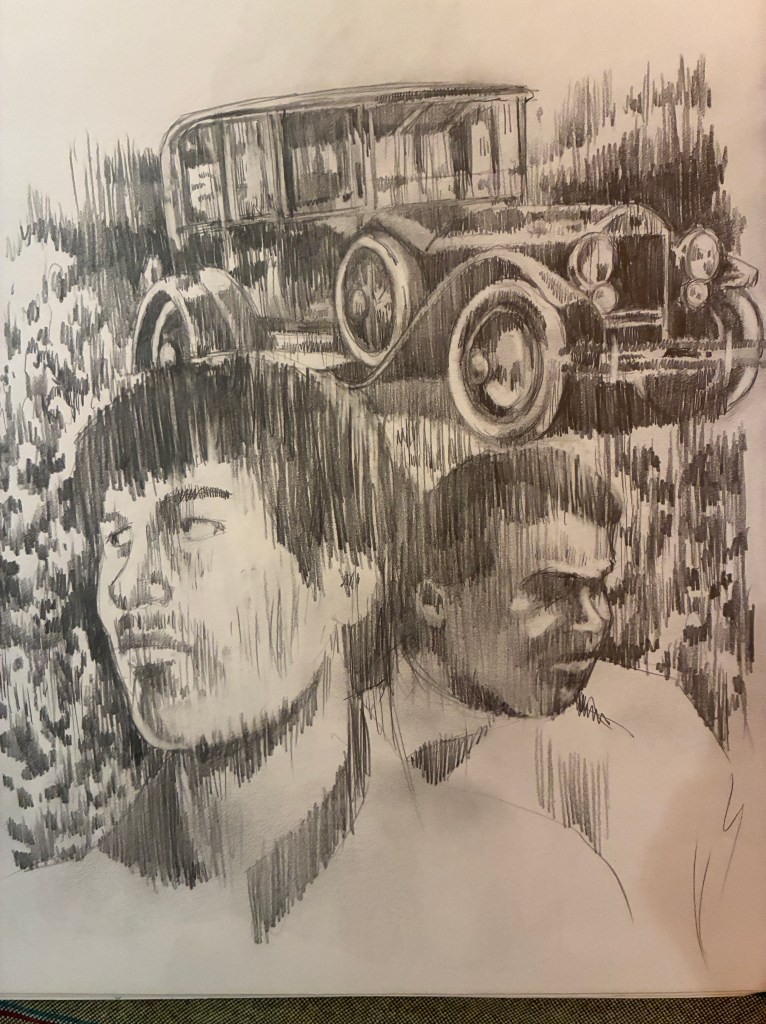
But as they were driving along what I imagine was quite a dark road, below the summit of the ridge, perhaps the indulgent husband a bit miffed at his wife’s paranoia, a massive torrent of water came suddenly cascading down the hill. A dam above them had burst. Their car was deluged and washed over the side of the road. Whatever the make and model, cars of that time had a high center of gravity and skinny tires, so it had little resistance to such a powerful onslaught, and there were certainly no life safety features incorporated in the design. One cannot imagine their shock as they realized in that moment of impact that this was the end for them. They were both drowned. And that is what my grandmother told me. It was then perhaps 35 years in the past, but the memory of that bizarre episode had remained with her, and all these years later her account has remained with me, so singular and strange it seems hardly in the realm of plausibility.
But sometime not many years ago, I mentioned this tale to my aunt, who died quite recently at the age of 103, and she corroborated it. She even remembered the name of the couple who had died and that invested new life in the old story. And the name seemed familiar. I had the feeling that I had met members of the family, perhaps the children or grandchildren, but if I had known then about their terrible loss they might have made more of an impression on me. No doubt their children had grown up in safety and comfort, cared for by someone else, a relative perhaps, and eventually they had children of their own, the people I vaguely recall, living lives that seemed much like any of ours, even though the demise of their parents must have cast an unfading shadow over theirs.
I have looked at maps, trying to figure out where and how this could have occurred, and indeed I have found on Google Earth what looks like a dam right at the top of the hill in the region of Northcliff. I cannot know for sure. But Northcliff, though a perfectly nice suburb, has always had a tinge of eeriness because of this event. No doubt the descendants of these people have what information exists and it is a bit frustrating to think that my failure to recognize them when I met them cost me the opportunity to question them, but perhaps this is a private history that resides too deeply within them to be shared with others. So here I am, almost assuredly the only descendant of guests at that party almost 100 years ago who is aware of this strange event, now a bit disappointed to realize that I will never learn all the details.
/////
Alan Sive is a frequent contributor to Lightwood. Read more of this work here. Scroll to our Search Button, insert his name and click.
Featured drawing by Alan Sive.
/////

Author Alan Sive grew up in South Africa under apartheid, which, aside from the political and cultural isolation, was a perilous environment for a gay teenager. He then moved to England and studied architecture at the Architectural Association School in London, but finding little work when he graduated, he moved to New York. He attended Columbia University Business School in the hope that an MBA would improve the chances of finding success in the US. This proved elusive. “There was malice involved, and bad timing, but primarily there was the AIDS crisis. Still, I am here. I have survived. Now there seems nothing else to do but to write.”
 Lightwood