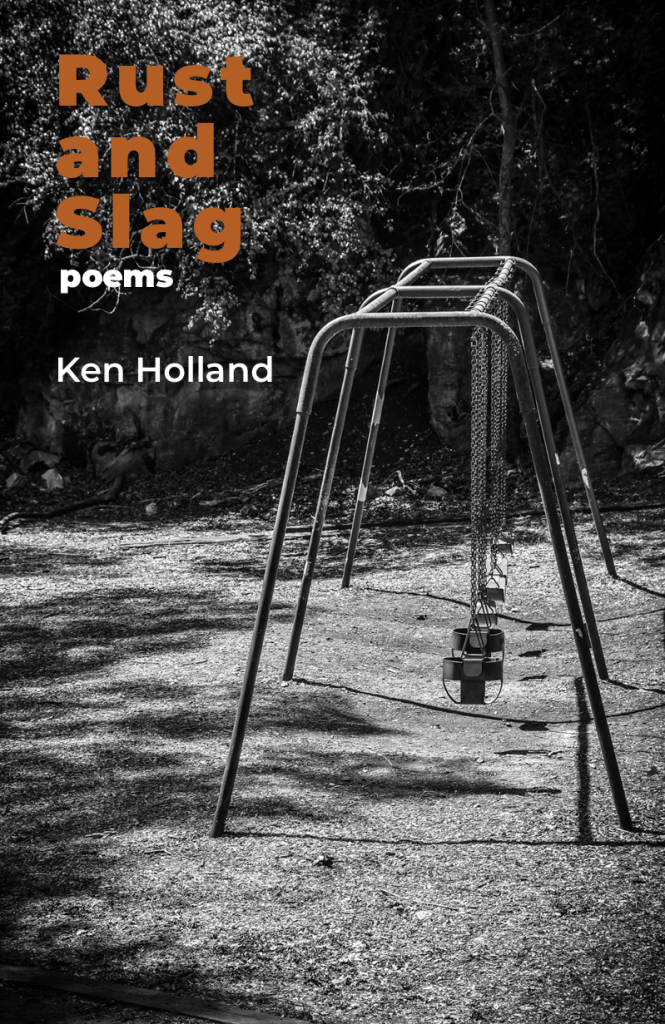
Ken Holland is a frequent contributor of poetry and book reviews to Lightwood. This time, I have the pleasure of reviewing his book: Rust and Slag, published by Moonstone Press, 2025.
I have to begin this by being transparent. I’ve known Ken and his poetry for a number of years and have always enjoyed reading his work and hearing him read at various venues around the Hudson Valley.

I’ve admired his ability to take the commonplace (even the mundane) and to bring a cosmic spin to things. And then to take cosmic and universal ideas (the big-ticket items that we face) and glide them onto an accessible, and sometime dryly humorous earthy plane. With Rust and Slag, he has accomplished both of these literary insights.

As I read through the book, a theme that emerged for me was the shifting of the permanent and the elusive and how they thread together through the writer’s memory. The book begins with the poem, “Home”, the working-class center of the universe.
“Childhood in a tract house:
eight feet of earth marking
the boundary between neighbors,
springing green for two weeks
every April
before dying back to the color of a tin can.”

An unromantic view, but one that sets the tone for the what’s to come. The poem is a stone thrown into Ken Holland’s literary pond which will create ripples that take us on a journey through the familiar and the unknown, from the natural world to our collective myths where light and dark and the gray days of life intermingle.

I was born near Pittsburgh, Pennsylvania and have a visceral response to poems that take me back to that place. The poet’s mention of the Monongahela River brings on a wisp of nostalgia. And even more with the mention of slag, a waste product in the steel-making process. In his poem, “Slag”, the poet brings an oddly beautiful line:
“The air smells of coal slag/ snow perversely white”

Many of the poems are intensely personal with lines that reveal a depth of feeling, a rawness that delivers its message from memories that are clear and just below the surface the poet’s life experience. From the poem “Iron and Air”:
“Doing without was the hymn of being poor, and God’s word/ The coinage against hunger.”

These pieces will ring true to many who have faced life’s trials early on while still maintaining their lyricism and imagery. And even dignity.

The journey continues with poems moving through time and space: from the rust belt to The Bronx, The Palisades, Grand Forks. It’s an inner and outer travelogue with poems of memoir, essay and autobiography. Each poem shifts us in time and space but never leaves us abandoned by the roadside.

On the page, Ken has brought the poems into a traditional boxed stanza format. This creates a style that unfolds each poem, one after another almost in a prose or flash-fiction format. The reader may want a little more variation in lines breaks and placement on the page, but the author’s presentation of them is solid and confident which draws the reader into the poems and makes one want to read further.

In a talk with Ken about the book, he mentioned that most of these poems are older pieces. They have been seasoned by time and no doubt numerous drafts, adding a deeper resonance. And although these pieces have been allowed to age (like cheese and wine) and many have been published in magazines and journals along the way (22 of the 28 poems), there is a freshness to them, a direct voice that will immediately connect with the reader. The book allows single poems to stand alone, while together creating an ongoing, powerful narrative. Readers of Rust and Slag will find both moments of meditation and strong, insightful connection. It’s a book that will open one’s own memory book.
/////

Ken Holland has had work widely published in such journals as Rattle, Atlanta Review, and Pedestal Magazine. He was awarded first place in several competitions including New Ohio Review, Kim Addonizio judge. His chapbook, “Rust and Slag”, was a finalist in the 2024 Concrete Wolf competition as well as the 2025 Moonstone Press competition which Moonstone subsequently published. His poem, “Sepia Life” was a finalist in Bicoastal Review’s 2025 contest. He’s been nominated three times for the Pushcart Prize and lives in the mid-Hudson Valley of New York. More by visiting: kenhollandpoet.com
 Lightwood
an inspiring read indeed
LikeLike