Even though not yet 140 years old, Johannesburg has experienced more incarnations than most cities might experience in 1000 years. From a mining camp established in 1886, a couple of years after the discovery of gold, set high in the semi-arid subtropical savannah grasslands of Africa, and reachable only by horse-drawn stagecoach over rutted paths, it quickly became the “Golden City” of my childhood with an array of amenities that one might have expected to find only in much older and larger cities. Not that it was ever a particularly beautiful city. The gold referred simply to the metal contained in the reef on which it was located. But the value of that metal enabled it to grow rapidly into a place that definitely had some status. Yes, the streets in downtown Johannesburg were narrow, and the blocks small, because the people who had laid it out believed that corner lots had greater economic value, so they designed lots of corners. No, there weren’t any great parks, just a few gloomy plazas here and there sporting mournful shrubs in pots, like the one outside the public library across from the City Hall, so in the 1960s when the Oppenheimer fountain was built next to the main post office and featured some actual water sprayed beneath a bronze arc of impala, a bit like the reindeer tugging Santa’s sleigh, it was an exotic addition to the urban fabric. This was a local anecdote, repeated tirelessly, that people were too busy making money in Johannesburg to worry about such frivolous things as urban beauty.
The narrow streets were lined with tall buildings, creating chasms of still, hot air. There were a few hotels and some department stores that dominated the retail environment as they did in most cities in those days, but mostly the buildings were occupied by offices located over street level stores, accessed directly from the street, as they would be in London or New York, and there was virtually no security. Why would there need to be when the Group Areas Act of 1950 had once and for all codified what had been the practice for decades? Black people could not enter the areas reserved for white people, such as downtown, without their “passbooks”, which had to be kept current with the signature of their employer. Since crime manifests itself most widely among the very poor, which in this case was the black population, segregation translated into notable safety – for white people.
And then it all came to an abrupt end in 1994 when the National Party government gave way to the ANC, in the most exciting election in South Africa’s history. With the end of apartheid came the end of the Group Areas Act, and it did not take long for the character of downtown Johannesburg to change dramatically. Once prestigious office buildings were taken over by desperate squatters and now accommodate the most violent criminal activity. Prominent structures have become burned out wrecks, with people living on high floors in darkness and squalor, without electricity or water, and frequently no glass in the windows because the frames have been ripped out and sold for a few pennies of scrap metal. No electricity means no elevators, no lighting and no heat, so the occupants light fires for illumination and warmth, and probably cooking too, which creates extremely unhealthy and dangerous conditions attested to by soot stains around the openings and a couple of massive fires recently in which dozens of people lost their lives. It is testimony to the financial costs of apartheid that the downtown area, containing once prime real estate that had cost billions of dollars to build, has been abandoned by the monied class, and a completely new city has been built several miles to the north, in Sandton, because there is unlimited land available to accommodate such a development and apparently no shortage of financing. The buildings of Sandton are quite glamorous, but they are like fortresses, with a single entrance, heavily guarded. The old downtown has been left to the hoi polloi, who are desperately poor and thus not likely to respect the limits of those who aren’t.
The photo below is the Florence Nightingale Maternity Nursing Home, were the author was born, as were nearly all white children in Johannesburg.
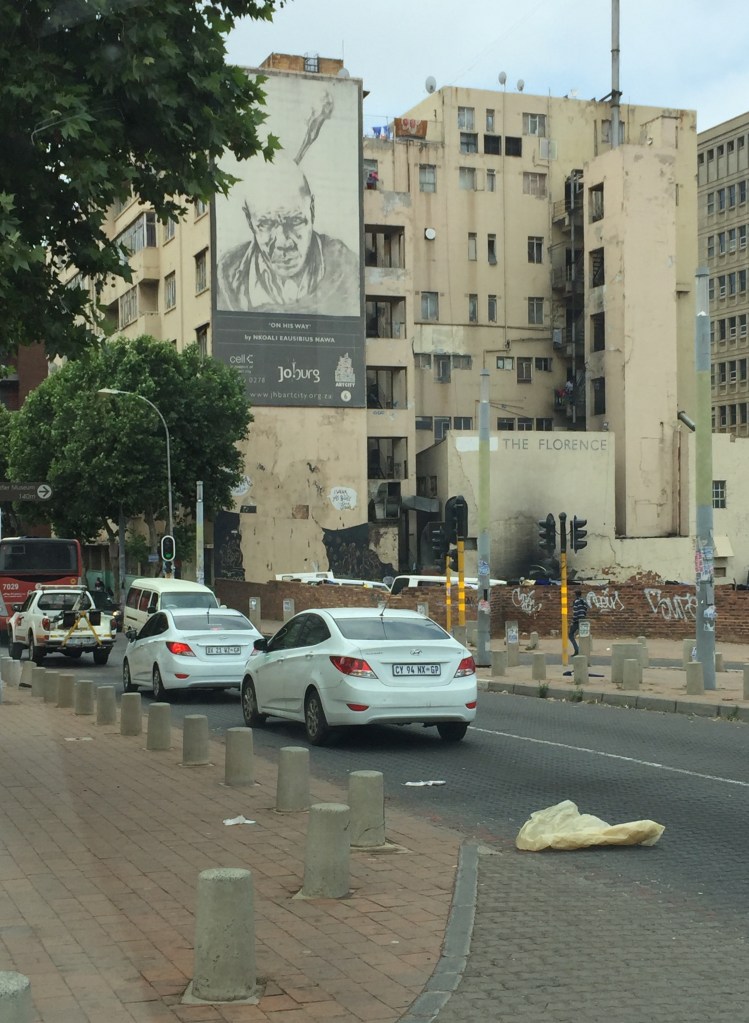
The street level stores have lost their facades, and it is more like a bazaar of varied and colorful stalls teeming with people. There may be some interesting businesses there, it’s true, but it’s too dangerous to investigate. I have seen them only from my cousin’s bullet proof car. It is quite sad to see the decay of those streets through which we used to walk so casually. They are never quiet these days, but they’re never safe either and one wouldn’t walk along them. A year or so ago Bree Street, on the northern side of downtown, experienced a huge explosion, in which the surface of the road literally blew up and cars and trucks were thrown into the air. It turned out that so much methane gas had accumulated in the blocked sewer beneath the street that it had finally combusted, a mournful paradigm for a moribund city.
We say that cities are organic creations, constantly evolving. Few cities have disappeared entirely, and certainly none in the last few hundred years. Johannesburg is unlikely to disappear, but it is hard to see how downtown Johannesburg can ever be resuscitated. Of course, the ineptitude and corruption of the ANC has aided and abetted this decline. The endless “load-shedding” – the regular and scheduled electric power cuts – and the water outages, combined with a decaying infrastructure that makes driving hazardous, are hardly features that are likely to attract new capital to the area, and so Johannesburg continues to deteriorate, even as a few stalwart citizens try hard to make it into something at least habitable. The “Golden City” is a distant memory.
/////
Read Alan Sive’s memoir/essays, “Moving On: The End of the AIDS Crisis in New York” and “That Was Then, The Old Johannesburg” here on Lightwood. Scroll to Lightwood’s Search Link and insert his name.

photo by Jonathan Freeman
/////
Author Alan Sive grew up in South Africa under apartheid, which, aside from the political and cultural isolation, was a perilous environment for a gay teenager. He then moved to England and studied architecture at the Architectural Association School in London, but finding little work when he graduated, he moved to New York. He attended Columbia University Business School in the hope that an MBA would improve the chances of finding success in the US. This proved elusive. “There was malice involved, and bad timing, but primarily there was the AIDS crisis. Still, I am here. I have survived. Now there seems nothing else to do but to write.”
 Lightwood