The last time I went to see Bob C. his mother and sister were there, and we sat quietly on the fire escape while his mother smoked a cigarette. Then I said goodbye to him. His mother took him back to Baltimore so she could care for him. He died on February 7, 1993 and is buried in his family’s plot. His obituary says he died of a viral infection. In 1993 there was still too much stigma for a respectable family to acknowledge that their son had died of AIDS.
We were now approaching the end of the carnage that had decimated our generation in New York. There were still people dying, but the deaths were now less frequent. The last of my close circle of friends died early in 1996. I ran into Craig as I was going into the bank on Broadway. I’d seen him not very long before, but I hadn’t been as diligent about visiting him as I might have because by then I was starting to wear out. It had been more than ten years of relentless visiting, helping, looking after and dealing with death and it was exhausting. Since our last meeting Craig had deteriorated quite noticeably, and he was so thin and so cold he was wearing a woolen hat although the weather was quite warm. I didn’t recognize him for a moment. He had to say his name, and I was mortified by my lapse. Still, he greeted me with such sweetness and such charm that I felt deeply remorseful about neglecting him. But then it was over, the visits, the anxieties, the funerals. It wasn’t that AIDS was over. There were still many fatalities, and in poorer communities in America and in Africa it had a long way to go. But here, in New York, in the gay community, it was winding down.

It felt like the end of a war when the fighting is finally over and at last you can survey the ruins of everything you have known and loved. It’s the time to start reconstructing life and moving on, but it’s also the time that the magnitude of the loss becomes evident, and the grief, so long repressed by the day-to-day turmoil, can at last express itself. For years afterwards, I experienced such deep grief it was as though I was carrying a weight that I could not throw off, and while over time – and to my surprise – the grief has become less intense, it never disappears. But although we were now moving into middle age, Jonathan and I were still young enough to have the prospect of some happy and productive years ahead of us.
The West Village was now mournful and quite shabby. Even the familiar streets seemed foreign because the activity that had once endowed them with character had vanished. Stores where once we had shopped were vacant and exhibited brokers’ signs soliciting tenants, and buildings where friends had resided, or even where you’d spent a single night with someone you’d just met in a bar, were now dilapidated, their blindless windows revealing the empty rooms within.
It took quite a few years for the Village to start its revival and then it was a bit jarring to see familiar spaces brought back to life by strangers, and to recognize that you no longer belonged to the crowd claiming dibs on it. It isn’t that anyone has a unique claim on the public spaces of New York or any city for that matter. In the city we walk on streets built by people long dead, and the streets and the buildings that line them will still be here long after we have gone. The city is a continuum in which one generation after another discovers new excitement in old places. It’s simply that for gay men of my generation the joyous times when this was our city, in which we directed the traffic, were so short, and ended so abruptly and in such sorrowful circumstances, it was difficult not to feel a little resentful of those who had moved into the vacuum.
Now the West Village was sought after by wealthy young families, many of whom, I understand, derived their affluence from Wall Street. For colossal prices they purchased their homes built as single-family residences in the 19th century, converted at some point to multi-family usage, and then restored them to their original single-family occupancy with every extravagance and convenience their money could buy. Luxurious new apartment houses sprang up in that area west of Hudson Street that had once been so excitingly iffy, including three designed by Richard Meier, the architect who years earlier had converted the old Western Electric/Bell Labs building on West Street to the Westbeth artists’ housing when West Street was marginal enough for a notable building to be dedicated to penurious artists. Side streets that had been gloomy and deserted now had doormen, and dog walkers, and planters around the sidewalk trees, and there were lights on all night. The last of the old piers was demolished and the Hudson River Park was constructed, and for a while Bleecker Street gave Madison Avenue a run for its money until the retail scene in Manhattan started to shift to big box and internet-based commerce.

The old abandoned elevated railroad tracks through west Chelsea that Bob C. and I used to wander along on Sunday mornings became the High Line, and today, when I walk along it, I remember the boys who once strolled there, in those long-vanished years. These days Washington Street is a chic little shopping strip where once was located the Mineshaft, one of the most notorious gay clubs in Manhattan. The road where sweat stained boys would reel out into the early dawn as carcasses slid on hooked tracks from refrigerated trucks into the meat packing establishments that defined the neighborhood is now crowded with oblivious pedestrians visiting from everywhere else to soak up the glamor.
The old Tiffany Diner that stood where West 4th Street runs into Christopher is now a bank, but before AIDS it was a 24-hour establishment where we would sometimes stop for breakfast after a very late night out in the clubs. One would see there the hustlers who had failed to turn a trick and drag queens looking a bit bedraggled in the bright light conversing over scrambled eggs and coffee. Though one could call it a bit seedy, it was also a wonderfully frank tableau describing a life of carnal pleasure that had expressed itself in public only so recently it seemed improbable that it was imminently going to implode into obscurity.
On St. Marks Place the St. Marks Baths became a video store and then something else. Did they fill in the pool in the basement? I so rarely walk on St. Marks Place these days I don’t know what its current incarnation is. I have passed the site obliviously, not even recognizing it as the former home of this lost temple of pleasure. On Second Avenue, where the Saint had briefly occupied the building that had once accommodated the old Fillmore East, just north of Sixth Street, there is now a savings bank. I find it impossible to reconcile its bland glass façade with the modest doorway that once admitted to the transcendent brilliance within the hordes of dancers, all wired and energetic after the obligatory pre-disco nap. Where now is a nondescript lobby bathed in fluorescent light was once a magical portal that channeled the patrons into a vast dynamic cosmic dome throbbing with music that today has been so frequently parodied it has become a cliché, the songs of the Age of Disco. What can possibly occupy this space now? Nothing that I care to investigate.
Towards the end of the 1990s, there was a new generation of gay men, too young to have experienced the AIDS crisis, and the center of gay life moved north to Chelsea. We now had once-a-day one-pill regimens, and soon PreP, so HIV was now a “chronic” condition that needn’t interfere with your life. From time to time one would run into someone familiar, perhaps a fling from years ago or someone one recognized from the bars, and it was thrilling to see someone else who had survived, and people would wave, or embrace, with wan smiles. Many of these survivors showed the scars of the epidemic. Those that had used protease inhibitors, the class of drugs that had been introduced in the early 1990s, often had signs of lipodystrophy, evident in sunken faces or misshapen bodies. Still, they were alive, and that counted for something.

But Jonathan and I had each other, and we now had our house. We equipped it with the enthusiasm that young people have for acquiring the possessions they will one day have to deal with disposing of, and I designed some striking furniture for it that we had fabricated by a very skillful cabinetmaker from whom I learned a lot about the structural challenges of furniture building. We entertained and we traveled, and we had a bunch of new nieces and nephews to enjoy. Jonathan was very busy with his career, as I believed I was with mine. It was as complete a life as one could have hoped might arise on the ruins left by AIDS.
Like all houses, ours is a repository for memories. We have things that belonged to our parents and our grandparents, and we have things that belonged to friends. We have lamps and pictures and boxes and bowls, and we have a little rug from a kid who died at 26 – he had bought this rug not long before he died, an adult purchase by a newly minted adult. Our crockery that we use all the time belonged to a cousin of Jonathan’s who died of AIDS in October 1988, and we have a tea service that we almost never use that belonged to a friend of Jonathan’s who died while we were building the house. And we also have, along with countless photos, mementoes of a long-vanished life, so alien and implausible it’s hard to believe it could ever really have been lived, except that it was my own young life so I can vouch for it.
/////
The painting and NYC photos are by Alan Sive. The author’s photo is by Jonathan Freeman.
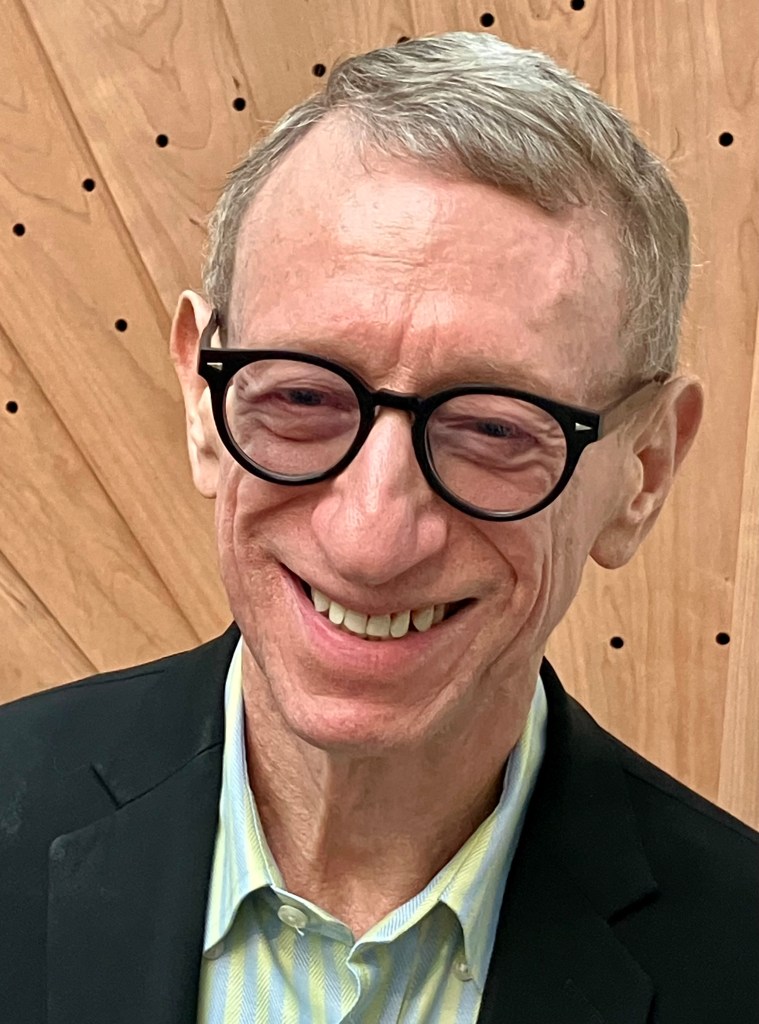
Alan Sive grew up in South Africa under apartheid, which, aside from the political and cultural isolation, was a perilous environment for a gay teenager. He then moved to England and studied architecture at the Architectural Association School in London, but finding little work when he graduated, he moved to New York. He attended Columbia University Business School in the hope that an MBA would improve the chances of finding success in the US. This proved elusive. “There was malice involved, and bad timing, but primarily there was the AIDS crisis. Still, I am here. I have survived. Now there seems nothing else to do but to write.” His memoir/essay, “Moving On: The End of the AIDS Crisis in New York” is part of a book-length work about his years in New York from the 1980s to the 2010s.
 Lightwood
Such a personal and honest account of this heartbreaking time in our history and how the city moves on regardless
LikeLike