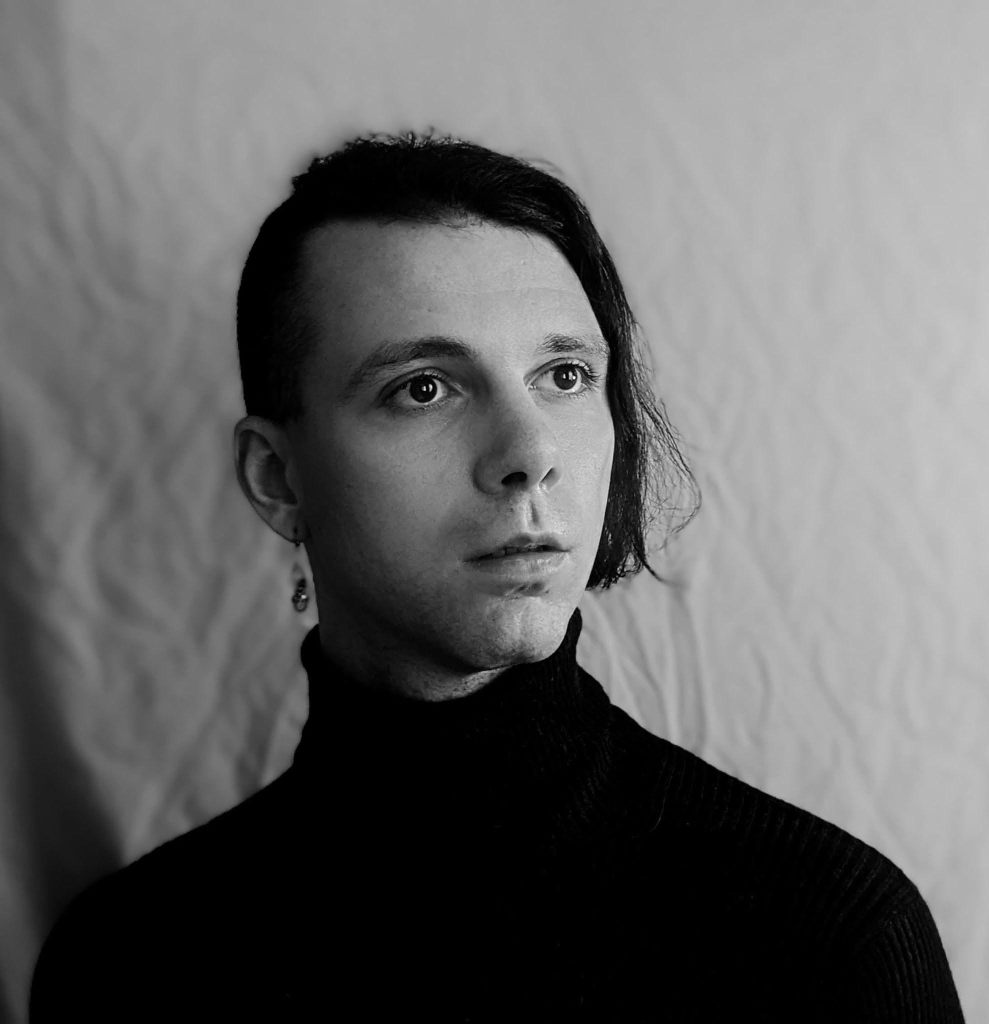
In Noah David Roberts’ fifth collection of poetry, they shock their audience with a collection haunted with memories of the past, an instability of the present, and a future strangled in the grips of hope and fear. Each poem melds the profound and the natural into one, letting the reader invest and take as much as they need, but providing only remnants of an answer in return. The collection encapsulates what it’s like to see a situation for what it is, to love as much as the words love, to hate as much as they hate. The love Roberts writes about is one that can feel apocalyptic and, at the same time, overwhelmingly pleasurable. They manage to make even the act of love-making something melancholic and even disturbing, as if the words “I love you” are the first and last ones they have ever heard in their life. We also see a fusion of mythology with a modern depiction of depravity, showing the timelessness of these tales and how the narrator’s actions act as a reverberation of these ancient stories.
Set primarily in the streets of Philadelphia where they currently reside, Roberts shows this city as an Elliot-esque “wasteland”, comparing their home to industrial-age London, post-war, stained with fire, gunshots impregnating the night. We are inundated with images of gutters, sewage, garbage, and disease, creating a sense of body-horror against the moving and living body of the city; something that is open and festering like a wound and enabling the promiscuous and savage state of existence in the darkness of such a place.
The collection is separated into three parts, each prefaced with Roberts’ collage work which provides a small collective of images to create a sense of context for each group. In the first part we see a comparison of joy/darkness, the second part is love/hate and the third is sour/sweet. Since the poems are written in oppositions, we are led to wonder what else is supposed to be felt from the conflict in their writing. In “Blood Orange” (57-59) all is revealed, as we read so blatantly the desperate need to find a sense of self and purpose through the intangible and imperfect conception of gender. The narrator wants to figure out which veil of gender suits them best and how they can best perform the role they feel they need to conform to on any given day. In the end the narrator comes to recognize, in a true and full sense, the depth of their trauma and how they must conquer it.
“Letters scattered on the wind,/ music scattered in the air,/ something missing/that was never really there – /now my therapist tells me/that I belong. When I say/it isn’t about the fruit/but about what the seeds can do,/they tell me that the pulp of an orange/is just as valuable; that/the flesh of such a fruit, tempestuous,/scintillating, ephemeral, temporary,/is as mutable as one’s identity. That it should be consumed like our past selves./This is all well and good, but an orange/still withers and turns black/in the sunlight. This is why/I only keep them out at night” (58-59)
Roberts clearly works in juxtapositions, adding hints of beauty into poems filled with darkness, leaving the reader wondering what is the line between real and absurd, what is their congruence and what is their distance? We see, most prominently, a comparison of the essence of joy with the perverse and disturbing,
“Joy came to me in my bed;/kissed my forehead, laid me back/down to rest, I saw/as a cockroach erupted from/a mouth, a tongue removed from joy, she/died in her own vomit,/hungover the next morning” (23).
Roberts reminds us here, and throughout each poem, that there cannot be a ray of light without a black cloud lurking in the distance, as they inject each poem with the macabre in this way.
Roberts proves the boundless nature of the dark, using their prophetic, resounding voice of protest that speaks for so many, for all those who lurk in the dark beside and away from them. The title poem “What I Do in the Dark” acts as the de facto spark that lighted the ignition of the rest of this collection, encapsulating the energy of their sentiments and putting into words what is this “manic insanity of [the] night” (28). At the end of the book, we are left with an understanding of how all that we do and live for during the day is a way to repent for all we have done in the dark.
Hope is exuded in their last poems, through a distinctly orange lens, as orange isn’t explicitly bright but becoming; existing in the space between yellow (light) and red (blood, pain, darkness). Their use of color and tangibility here is both scintillating and synesthetic, drawing so much emotion from what feelings these colors exude. This where our narrator exists at the end of the collection, acknowledging that they teeter on the edge of each side, towards true light and true dark, yet the last line of the last poem, “It is morning”, screams to the reader that there is indeed a sense of resolution for our depraved narrator, as “morning” functions as a literal visualization out of the darkness of the night; a way to start anew and be rid of the hopelessness of the dark and to move towards something that is light, yellow, and full of joy.
You can find and purchase Noah’s book on their website, noahdavidroberts.com, and, if you are in the Philadelphia area, you can catch their open mic event, Scribes on South, that they host the last Sunday of every month at Tattooed Moms, in downtown Philadelphia.
/////
You can read additional work by Noah David Roberts here on Lightwood by clicking on our search button.
Noah David Roberts is a non-binary poet based in Philadelphia, PA. Roberts is the author of 5 collections: Us v. Them, Strips, Slime Thing [and other poems], Final Girl Mythos, and What I Do in the Dark. Since the publication of their first book, Roberts has been published in Bullshit Lit, Tribes Magazine, Horror Sleaze Trash, and more. In 2022, Roberts won the Judith Stark poetry contest. Roberts is a reader at Graphic Violence Lit, and loves cats. Their Instagram handle is @the.apocalypse.poet.

/////
Reviewer Robyn Hager is a frequent contributor to Lightwood. Her poems and reviews can be read here by clicking on our Search Button.
 Lightwood